
Do You Toile?
Mid-Term Enrolments Welcome 〰️
Mid-Term Enrolments Welcome 〰️
DO YOU TOILE?
A few months ago, a printer repairer who was visiting the studio remarked that many of my students were sewing rather odd looking garments – all in the same very plain fabric. Of course he was referring to toiles or muslins (as they’re called in North America). I smiled as I explained what was going on but also (inwardly) lamented that so much of the hard work and genius that takes place in the studio isn’t exactly Insta-worthy!
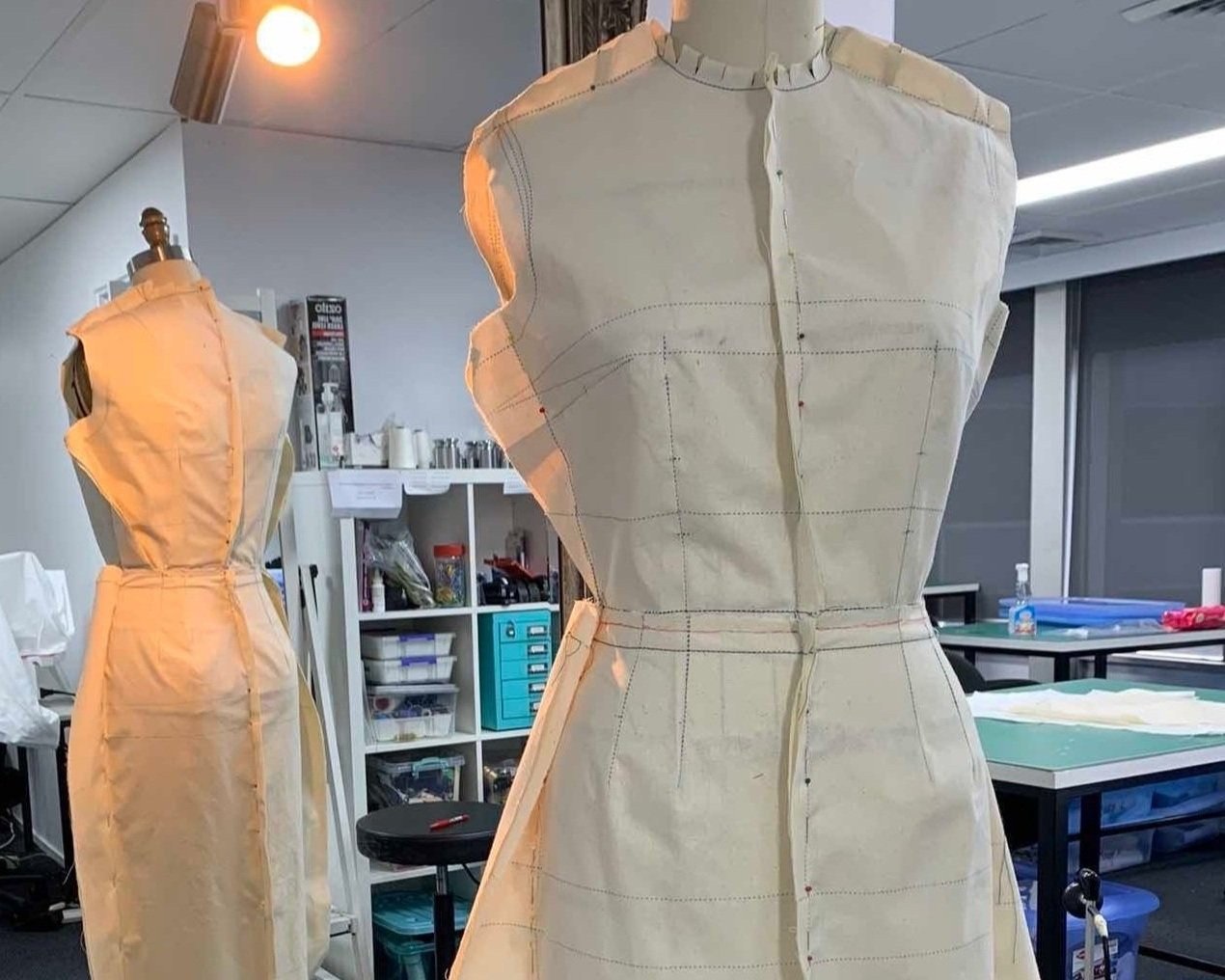
So what is a toile and just how do you pronounce it?
A toile (pronounced twarhl) is a prototype or fitting version of a garment, made in an inexpensive fabric so the design and fit can be tested and perfected. The name comes from the fabric originally used to make them — a translucent linen or cotton. These days, most toiles are made using calico or muslin. If you’ve accumulated a swathe of gorgeous fabrics in your stash but you’re too afraid to cut into your treasures, read on.

Is a toile the same thing as a muslin?
This is where it gets a tad confusing — especially for Trans-Pacific sewers. A toile and a muslin are both test garments, but muslin can also refer to the fabric used to make one, particularly in North America. Both can be made in calico or muslin. A little pedantic perhaps, but good to clear up at the beginning.
Do you always use calico or muslin for a toile?
There are good reasons why calico or muslin is the go-to choice for toiles. It’s inexpensive and, most importantly, it’s a stable woven fabric. This makes fitting and design issues easy to see, while neutral calico provides a clear background for construction and fitting marks — you can even write your notes directly on the toile. If your final garment will be made in a more fluid fabric, such as silk charmeuse or jersey, choose an inexpensive toile fabric with a similar hand and drape. Your toile needs to behave in a similar way to your final fabric — for example this peach polyester crepe.

Toiles aren’t just for fashion designers.
Even if you’re sewing from a commercial pattern, making a toile gives you the chance to resolve fitting issues before you take your scissors to the good stuff. And don’t be too hard on commercial patterns. After all, how could any pattern account for the enormous variety of human shapes and proportions?
It’s all about the fit.
Commercial patterns are designed around standardised body measurements, but very few of us are standard. A toile lets you see where a pattern works for your body — and where it needs adjusting.
Balance lines make this even easier. Mark horizontal and vertical balance lines on your toile before fitting. When the garment is on the body, they should sit level and hang straight, making drag, twisting and other fitting issues much easier to spot.

A toile gives you the confidence to try new techniques
I’ve seen so many sewers in the studio who are reluctant to expand their skillset and stick to the basics — which is fine. But for me, part of the joy of sewing is making something beautiful and unique, and the sense of reward that comes from completing a garment that will last for years. If you’ve never tried a welt pocket (and simply omit them from your jackets), a toile is the perfect place to start. I’ve also lost count of the number of students with a full bust who routinely choose a pattern size (or two) bigger and wonder why their finished garment resembles a shapeless sack. A toile will enable you to trial a number of techniques to achieve a perfect fit.
If you’re creating a new design, the pattern needs to be tested.
Essentially, a toile takes a 2D flat pattern and transforms it into a 3D garment to fit the body. One of the most important aspects of the process is testing and perfecting sewing and finishing techniques, then determining the right sewing order. There’s a reason why patterns specify each sewing step in a specific sequence and when you start to design your own garments, you’ll quickly start to appreciate this. Sewers often find that their finished garment evolves in a different direction to their initial concept sketches and making a toile facilitates this. Even if you’re working from a tried and tested pattern block, new designs and details will emerge and a toile will show you what this will look like on a finished garment.

Keep notes and photos.
When your toile is coming together and you’re in the zone, there’s a tendency to assume that you’ll remember all of the steps in the process, not to mention all of the markings that you’ve made. My advice is to keep detailed notes for each toile and to supplement these with photographs (or visual notes) — especially for the more complicated or intricate finishes or steps. Almost all of us have a smart phone at arm’s length, so there’s really no excuse not to do this!
Do you need your own dress form or dressmaker’s dummy?
If you don’t have someone who can help you with fitting (and it’s debatable how much “help” an ambivalent partner with pins really offers), a dress form is invaluable. Especially for fitting the back of a pattern. Dress forms also suffer from many of the same issues as commercial patterns (standardised, average body types), but some of them are adjustable or you may be lucky enough to conform to “fit model” measurements. Alas, this is really rare … from my experience, about 1 person in every 80-100. We currently have only one student in all of our classes who’s a fit model and we try really hard to conceal our envy : ) We also run a specialised class where you can make your own dress form to your personalised measurements.
Doesn’t it just add to the cost?
Sure. It absolutely does add to the overall cost of a garment, but in my experience, this is balanced out by the cost of throwaways, UFOs (unfinished objects) or mis-cuts … the sad failures we mournfully stash in the depths of our sewing rooms. There’s also the thrifty option of using old curtains or sheets – op shops are a good source for these. Who knows what else you might find – be sure to rummage for vintage patterns and buttons as well.
Is it worth the extra time?
You don’t have to make a complete toile for every garment you make (sometimes a quick result is what you’re after), but it’s such a great way to elevate your skills and turn “home-made” into “couture”. As a teacher, there’s nothing more satisfying to see an excited student complete the last stitch of a garment, try it on for a final time and say: “this is the best thing I’ve ever made”.
Say yes to the toile!